
Keep PDFSTOOLZ Free
If we saved you time today and found PDFSTOOLZ useful, please consider a small support.
It keeps the servers running fast for everyone.

🔒 100% Secure & Private.
Don’t let formatting issues slow you down. Our guide to pdf to word how to ensures your documents look perfect.


Introduction to Digital Setlist Management
Musicians constantly face massive organizational challenges. Specifically, managing paper sheet music for a live performance is incredibly tedious. Consequently, many modern artists have transitioned to digital tablets. However, static document formats often limit your performance flexibility. Therefore, mastering the pdf to word how to process is essential for your efficiency. This guide will show you how to convert your locked files into editable templates. Thus, you can rearrange your setlists with absolute ease.
Moreover, digital transition requires deep technical knowledge. Many instrumentalists do not know how to manipulate electronic documents. Consequently, they struggle with oversized files and rigid layouts. This article provides a comprehensive solution for these common workflow roadblocks. Therefore, you will learn to manage your charts with professional speed. Ultimately, you will gain complete control over your gig preparation.
The Modern Musician’s Dilemma with Static Files
Static documents protect original designs. However, this absolute rigidity represents a major drawback for gigging instrumentalists. For instance, you cannot easily change a key signature on a flattened file. Additionally, you cannot quickly delete an unwanted chorus during a rehearsal. Therefore, locked formats frequently slow down your band communication. Consequently, rehearsals become highly inefficient. You must find a way to make your music files flexible.
Furthermore, different gigs require customized song structures. For example, a wedding performance demands a different arrangement than a studio session. Thus, you must have the ability to edit your lead sheets instantly. If you use static files, you will waste hours writing hand-written notes. Instead, you need editable text documents. Therefore, converting files is the most logical choice for working performers. This technique saves your valuable time on stage.
Mastering the PDF to Word How To Process for Your Setlists
To begin this conversion, you must choose the correct utility. Indeed, the pdf to word how to technique requires professional software for high-quality results. You must avoid cheap online converters because they ruin musical formatting. Instead, you must use reliable desktop tools. This choice ensures that your music staves remain intact. Consequently, your chord symbols will stay aligned with your lyric sheets.
Moreover, the conversion process must preserve document layouts. Musical notation relies entirely on precise spatial relationships. Therefore, you must select tools that specialize in document reconstruction. Once you master this pdf to word how to methodology, your preparation workflow changes forever. You will quickly build a highly responsive music library. Consequently, your live shows will run much smoother.
Why Editability Matters on Stage
Live performances are highly unpredictable. Therefore, you must adapt your charts at a moment’s notice. For example, a vocalist might request a lower key during soundcheck. If you have editable files, you can transpose chords immediately. Conversely, static documents will force you to transpose mentally. This mental math increases your chances of making mistakes on stage. Thus, editability acts as a safety net.
Additionally, stage monitors often display content differently. Consequently, you must adjust font sizes for dark stage environments. By converting your files, you can enlarge chords for better visibility. Moreover, you can highlight complex musical cues. Therefore, editable charts directly improve your live performance accuracy. You will never squint at small fonts again.
The Real-World Example: Marcus’s Last-Minute Wedding Gig
Let us look at a real-world scenario. Marcus is a professional keyboard player in Chicago. Recently, he booked a high-paying wedding gig. However, the bride changed the bridal march song three hours before the ceremony. Consequently, Marcus had to transpose the entire piece down a minor third. Furthermore, the new key had to be shared with the saxophonist instantly.
Because Marcus knew the pdf to word how to technique, he converted his static sheet music file. Subsequently, he opened the document in Microsoft Word. He used a transpose tool to update the chord symbols. After that, he was able to organize sheet music documents for his band mates. Consequently, the band performed the song flawlessly. Marcus saved his gig and secured a massive tip.
PDF to Word How To: Step-by-Step Desktop Guide
First, download and launch a professional document editor. Consequently, open the static file that contains your musical chart. Navigate directly to the export menu on your screen. Therefore, you must select the option to convert to docx format. This file type ensures maximum compatibility with Microsoft Word. Thus, you begin the transformation process.
Second, click the export button to start the analysis. The software will scan your musical markings and text lines. Moreover, it will reconstruct the paragraphs on your screen. Once the conversion completes, save the new document to your computer. Consequently, you can open it directly in your favorite word processor. This completes the essential pdf to word how to technical routine.
Preserving Chord and Lyric Alignment
The biggest challenge during conversion is preserving spatial alignment. For instance, chords must sit directly above specific words. However, cheap conversion software often shifts text blocks randomly. Consequently, your chart becomes completely unreadable. Therefore, you must check your alignment after every conversion. This ensures that your band mates do not get confused during a show.
To fix alignment issues, you should use monospaced fonts. Specifically, fonts like Courier New keep characters perfectly aligned. Moreover, you should use tabs instead of spaces. This formatting trick prevents text from drifting on different screens. Therefore, careful editing preserves your chart structure. Thus, you maintain professional reading standards.
PDF to Word How To: Free and Open-Source Alternatives
Many independent musicians work on tight budgets. Consequently, they cannot afford expensive software subscriptions. However, you can still execute the pdf to word how to method without spending money. Specifically, you can use LibreOffice Writer to open your static documents. This free tool performs admirable conversion work. Therefore, budget restrictions will not stop your workflow.
Alternatively, you can use Google Docs for your conversions. First, upload your document to Google Drive. Subsequently, open the file with Google Docs directly. The platform will automatically convert your text. Moreover, this method allows for easy online collaboration. Therefore, you can share the editable document with your band instantly. Thus, open-source tools provide incredible value.
Pros and Cons of Sheet Music File Conversions
Before changing your entire file system, you must weigh your options. Therefore, let us look at the detailed pros and cons of this workflow.
- Pro: You gain total control over your song arrangements and chords.
- Pro: Transposing keys becomes a quick search-and-replace task.
- Pro: You can easily merge files to create continuous setlist books.
- Con: Complex musical notation may experience minor formatting shifts.
- Con: Low-quality scans require extra manual correction after conversion.
Consequently, you must balance these advantages against potential formatting cleanups. For most gigging musicians, the editing freedom far outweighs the initial setup time. Therefore, you should adopt this conversion strategy. Ultimately, your stage performance will benefit greatly from this change.
How to Compress PDF Sheet Music Files Efficiently
Large sheet music books often contain massive high-resolution images. Consequently, these heavy files slow down your tablet reader app. To prevent performance lag, you must learn to compress pdf files. This technical step reduces the overall file size while preserving readability. Therefore, your digital music stand will turn pages instantly.
Moreover, smaller files are easier to send via email. For example, some email providers reject files over twenty-five megabytes. Thus, you must reduce pdf size before sharing charts with your horn section. By doing this, you ensure that every musician receives their music. Consequently, your band rehearsals will start on time. This optimization is a fundamental step in digital library management.
The Ultimate Power of How to Merge PDF Files
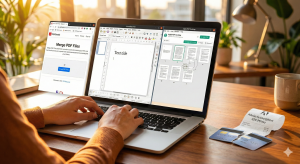
During a fast-paced concert, you cannot search for individual files. This search creates awkward pauses between your songs. Therefore, you must learn to merge pdf files into a single master setlist. This single document should contain every song in performance order. Consequently, you only need to scroll forward to see the next chart.
Furthermore, compiling your sheets keeps you focused on the crowd. You will not stress about finding the next song in your directory. Instead, you can focus entirely on your musical expression. Thus, combining your documents creates a professional flow. Therefore, you should compile your setlists before every live performance. This preparation separates amateurs from professionals.
Why You Need to Split PDF Books into Individual Songs
Conversely, you might download a massive fake book containing hundreds of jazz standards. However, your band might only perform three songs from that book. Consequently, carrying the entire book on your tablet is unnecessary. Therefore, you must learn to split pdf files into smaller parts. This process allows you to extract only the pages you need.
By isolating your target songs, you keep your digital workspace clean. Additionally, you save valuable storage space on your mobile device. Moreover, finding specific songs during a rehearsal becomes extremely fast. Therefore, splitting files is just as important as merging them. Consequently, you must master both techniques to maintain an organized library.
How to Delete PDF Pages to Clean Up Your Sheet Music
Many digital files contain useless filler pages. For instance, they often include title sheets, licensing agreements, and blank pages. Consequently, these extra pages disrupt your flow during live performances. Therefore, you must learn to delete pdf pages that do not contain musical notes. This action declutters your reading screen completely.
To do this, use a reliable page manager tool. Simply select the unwanted pages and remove pdf pages permanently. Thus, your digital sheets will transition seamlessly from page one to page two. Moreover, this clean presentation reduces visual distractions. Therefore, you can perform with greater mental focus. Clean charts lead to cleaner performances.
Using OCR for Scanned Sheet Music
Many old sheet music charts are simply photocopies. Consequently, your computer treats these files as flat images. Therefore, you cannot search for words or highlight specific chord changes. To solve this, you must apply ocr technology. This process scans the images and turns them into selectable text characters.
Once the character recognition is complete, your sheets become fully interactive. For example, you can search for the term “chorus” to navigate instantly. Moreover, this scan prepares your file for an accurate pdf to word conversion. Therefore, character recognition is a crucial step for old archives. Consequently, you can modernize your vintage music collection without manual retyping.
The Reverse Loop: Converting Word to PDF Before the Show
Once you finish editing your chord charts in Microsoft Word, your work is not complete. Indeed, you should not read docx files directly on your performance tablet. This format can display differently across various devices. Therefore, you must perform a word to pdf conversion before your show. This step locks your formatting in place.
Consequently, your charts will look identical on every tablet screen. Whether your bassist uses an iPad or an Android device, the notation remains consistent. Moreover, this locked format prevents accidental edits during a high-energy performance. Therefore, always complete the conversion loop. This final step guarantees structural safety on stage.
Protecting Your Intellectual Property with PDF Watermarks
As a composer, you spend hours writing original arrangements. Consequently, you must protect your musical creations from unauthorized sharing. Therefore, you should learn to pdf add watermark to your digital sheets. This process embeds a semi-transparent text layer across your pages. This text can display your name, email, or copyright year.
Furthermore, watermarking deters illegal distribution within the music community. If a musician shares your chart, your name remains clearly visible. Thus, you preserve your creative ownership. Additionally, this step adds a level of professional branding to your sheets. Therefore, you should watermark your work before sending charts to online clients. This is a smart business move.
How to Sign PDF Contracts Digitally
Professional musicians handle many business agreements. For example, you must sign venue contracts, tax documents, and session agreements. Printing, signing, and scanning these documents is incredibly slow. Therefore, you must learn how to sign pdf documents digitally. This modern workflow allows you to sign contracts with a single click.
Moreover, digital signatures are legally binding in most countries. Consequently, you can book gigs and close deals in seconds. You do not need physical paper or pens. Thus, this process keeps your business organized and highly professional. Therefore, digital signatures are essential for modern career advancement. They save you time that is better spent practicing.
Managing Digital Music Stands and Tablet Optimization
Using a tablet on a dark stage is a liberating experience. However, your device must be highly optimized. Consequently, you must organize pdf files into specific playlists within your reading app. This categorization ensures that you can pull up request songs in seconds. Moreover, organize your files by genre or tempo for quick access.
Additionally, keep your operating system updated. System updates prevent sudden app crashes during a live set. Furthermore, back up your digital library to a cloud service weekly. If your tablet breaks, you will not lose years of curated charts. Therefore, digital library maintenance is critical for every working musician. This discipline prevents catastrophic stage failures.
Best Practices for Clean Chord Chart Layouts
When you edit your sheets, formatting simplicity is key. For instance, avoid using overly decorative fonts. These fonts are highly illegible under dim stage lights. Instead, select clean, bold sans-serif typefaces. Furthermore, leave adequate margins around your musical notation. This breathing room makes your charts easier to read during fast tempos.
Moreover, use bold capital letters to highlight song sections. For example, write “VERSE 1” or “CHORUS” in a larger font size. This visual hierarchy helps your band mates find their place quickly if they get lost. Therefore, clean layouts directly improve your band’s tight sound. Consequently, your audience will notice the professional musical cohesion.
Personal Opinions: Why I Avoid Automated Apps
In my professional experience, automated chord transcription apps are highly unreliable. Specifically, they often mistake complex guitar extensions for simple major triads. Consequently, these apps produce highly inaccurate charts. Therefore, I always recommend converting documents manually. This hands-on editing approach guarantees absolute musical accuracy.
Moreover, automated tools lack human musical intuition. They do not understand the emotional flow of a live setlist. Conversely, editing your charts manually allows you to add specific performance notes. You can write down dynamics, tempo changes, and vocal cues. Therefore, you must avoid lazy automation shortcuts. Your performance quality deserves your personal attention.
Troubleshooting Layout Collapses
Sometimes, your converted document will look like a total disaster. For example, your musical symbols may turn into strange gibberish characters. Consequently, this layout collapse can cause frustration. To solve this, check your font compatibility. Often, the conversion software lacks the specific musical fonts used in the original document.
To resolve this, install standard music fonts on your computer. Alternatively, export your sheets as high-resolution images first. Subsequently, convert those clean images into editable formats. Therefore, troubleshooting requires patience and technical trial. Once you understand these quick fixes, conversion errors will not slow you down. You will handle any file issue with total confidence.
Alternative Document Formats for Band Collaboration
While Microsoft Word is excellent, sometimes you need other formats. For instance, if your keyboard player uses Apple Pages, file sharing can get complicated. Therefore, you must consider universal formats. In addition to docx, you can export your charts as rich text format files. This format preserves basic text alignment across all editing software.
Alternatively, you can convert your files to markdown formats. Specifically, this text-based system is incredibly lightweight. Moreover, it is easily readable on any mobile screen. Thus, you must choose the format that best fits your team’s devices. Therefore, flexible formatting options ensure smooth collaboration. Your band mates will thank you for your technical adaptability.
Final Practical Advice for Working Musicians
Do not wait until the night of a major gig to organize your charts. Consequently, last-minute technical panics will ruin your performance focus. Instead, set aside one day a week for digital library maintenance. During this time, clean your files and update your setlists. Therefore, you will arrive at your venue completely relaxed.
Additionally, always pack a backup paper copy of your setlist. While digital tablets are amazing, batteries can die unexpectedly. Consequently, a paper backup acts as your ultimate insurance policy. Thus, professional musicians prepare for every possible technical scenario. This level of dedication is what truly separates working pros from hobbyists.
Conclusion: Elevating Your Gig Preparation
In summary, mastering digital document management is a modern musical superpower. By learning how to convert, merge, and split your files, you take full control of your creative output. Therefore, you will spend less time organizing paper and more time playing your instrument. Consequently, your live performances will become tighter and more professional.
Moreover, these technical skills will save your band during high-stress situations. You will handle last-minute transpositions and setlist changes with absolute ease. Therefore, implement these digital tools today. Do not let static formats limit your creative potential on stage. Ultimately, your musical journey will reach new heights of professional efficiency.